200 hour yoga teacher training:
Course curriculum
An overview of everything we’ll cover together during the YTT.
The whole curriculum is structured to explore the overlap between science and spirituality, and the practical applications of ancient wisdom in a modern-day context. Rather than studying each module separately, they’ll overlap and intertwine as we progress throughout the training.
History of yoga
Explore the origins of the practice and how it’s evolved over time.
-
Gain an overview of yoga’s most defining eras and key texts. We’ll trace the evolution of the practice from its philosophical and spiritual foundations, through to the modern day practices we enjoy today.
-
Examine yoga in a modern-day context, and explore the ways in which we can keep its traditions relevant, while still respecting the cultures and lineages they come from.
This includes open discussion around many of the positive shifts, but also which aspects may have been diluted, simplified, or lost along the way.
-
Acknowledge the complex history of yoga, including the role of colonisation, social influence, and economic exploitation - and how these are still shaping the practice today.
We’ll look at the globalisation of yoga as an industry - from its roots, to the rapid rise in popularity that we see today.
Some of these conversations may feel challenging, but they’re essential to understanding yoga’s full story, and your role within it.
Philosophy
Problem solving in practice: using thousands-year-old wisdom to navigate modern-day life.
-
When done well, studying philosophy should leave you with more questions than answers. Questions that arise from curiosity, not confusion. Hopefully you’ll ignite some intrigue and desire to dig deeper into the frameworks as a way to make sense of the world, and of yourself.
-
Yoga philosophy provides us with wonderful frameworks for understanding ourselves better, including how we make choices, react to change, or deal with challenging situations.
We’ll study the theory of these frameworks and then put them to practice in real life, using them as tools for deep discussions on yoga, life, and (modern-day) liberation.
-
Study yoga as “skill in action” - and what that means for your off-the-mat practice. The text offers a powerful lens to explore roles and responsibilities, ethics, and social justice. We’ll use the teachings to discuss decision making, desire, discomfort, and detachment.
-
The Yoga Sutras provide a systematic framework for understanding both the theory and practice of yoga. We’ll work with the eight limbs as a foundation, before diving deeper into the inner workings of the mind, and exploring concepts such as suffering, contentment, and habits.
-
Ayurveda is one of the world’s oldest holistic healing systems and it’s based on the belief that health and wellness depend on a delicate balance between mind, body, and spirit, with the primary goal of promoting good health, not fighting disease.
Rooted in the five elements (earth, water, fire, air and ether), Ayurveda emphasises the deep connection we share with nature and its cycles. It’s the combination of these elements that make up the three doshas, which influence our personalities, habits and health.
Off-the-mat
Expanding your practice beyond the boundaries of your yoga mat.
-
We explore how social norms, beliefs, and biases influence our practice and teaching, and what it means to take responsibility for both our intentions and our impact.
We’ll also unpack challenging but essential topics such as spiritual bypassing, power dynamics, privilege, and propaganda. These conversations help build awareness around how harm can occur (even unintentionally), and how yoga can be used as a tool for both personal healing and meaningful change beyond the mat.
-
We examine the line between cultural appropriation and appreciation, and explore how to engage with yoga in a way that is respectful, informed, and inclusive. The focus is on making yoga accessible, ethical, and enjoyable - without erasing its roots or oversimplifying its traditions.
-
Yoga doesn’t end when class finishes. This section explores how practice extends into everyday life and shapes our ethics, values and relationships.
Ethics are rooted in relationships - how we interact with ourselves, others, and the world around us, through our thoughts, words, and actions.
The thing is, ethical behaviour is rarely black and white, and in many situations there simply isn’t a right and wrong, therefore, navigating the grey zone with integrity is key.
Rather than searching for a single “right” answer, we’ll embrace the notion: it depends.
The mind-body
The fascinating body-brain-breath connections.
-
When we visualise the nervous system, we often think of the flow diagram we learned in biology lessons - but this boxed approach over simplifies it and makes humans feel more like machines with fixed settings. That’s not the reality.
We’ll take the wisdom of yogic discoveries and overlap this with what the science now supports.
Get ready to be mind-blown, not brain-boggled - I love sharing this nerdy stuff in an accessible (and fun) way.
-
Understand your “inner computer” but in a less robotic way. We’ll look at proprioception, interoception, and how we process sensory signals - as well as why this matters in real-life.
It ties in really nicely with what we cover within the philosophy lectures too.
-
Gain an insight into how movement, breath, and awareness shape our mental and emotional states (and vice-versa). It’s honestly really cool!
-
Understand what’s happening behind the scenes when something hurts - and more importantly, how you can help ease the aches and pains.
Learn how the nervous system processes pain and danger, and why pain isn’t always a direct reflection of tissue damage.
Knowing this may shift your relationship with movement and how you choose to guide your classes - at least I hope it does.
The subtle body
An exploration of energy and the invisible.
-
Not everything that shapes our experience can be measured or easily explained - but that doesn’t mean it should be dismissed.
Explore how yogic traditions describe energy and subtle experience, without framing it as something mystical or removed from everyday life.
This section focuses on making energy concepts tangible, relatable, and useful in practice.
-
Learn about the chakra system and energy channels within the body. I teach the chakra system in its traditional format, not the rainbow system that became popular in the 70s. This gives you a more grounded understanding of how to work with them.
-
We’ll take a deeper look at the various “layers” that make us whole - and how these layers interact with each other.
The pancha kosha model describes the interconnected relationship between body, breath, mind, and emotions, and their influence over each other - for example, how our physical movements and posture affect our breathing and brain, and vice versa.
It’s a perspective that’s supported by modern science - and also one of my all-time favourite topics to teach.
The breath
Exploring the mechanical, physiological, and energetic dimensions of your inhales and exhales.
-
We look at the science behind breathing and how it creates a ripple effect through the whole body.
This includes the respiratory system, the nervous system, and the energetic side of breath (prana) - giving you a clear picture of why working with your breath can be powerful on many different levels.
-
You’ll practice pranayama and a range of breathing techniques designed to either energise or calm the nervous system.
The focus is on noticing how different techniques affect you, rather than trying to perform breathing in a particular way.
-
We work with the prana vayus to help movement and breath feel connected and cohesive - no more mechanical inhaling and exhaling your way through a flow.
If your breathing has become background noise or an after-thought, this will bring it back into focus.
-
Learn how to teach breathing practices in a way that’s accessible and safe, and how to support students in developing a more mindful relationship with their breath. This includes knowing what to guide, when to simplify, and when to stay silent.
Meditation
Paying attention on purpose: focus, concentration, and resting-bliss-face.
-
There’s a common misconception that the goal of meditation is emptiness or nothingness, but the aim isn’t to “turn off” our thoughts or feelings, it’s to observe them without judgment, while resisting the temptation to interact or engage with them.
I know it’s easier said than done, but we’ll work on that together.
-
Begin to understand the internal chatter of your mind, and how it shapes (and is shaped by) your experiences.
Explore effective ways to practice patience and cultivate peacefulness - without forcing yourself to sit still and be calm.
-
Explore different mindfulness techniques that use objects, sensations, or simple activities as anchors for attention.
The aim isn’t a constant blissed-out state, but paying attention on purpose so you notice when your mind wanders - and have the tools to refocus in a way that’s kind rather than critical.
-
Meditation becomes more powerful when it’s a regular practice, rather than a random hour sat in silence. It doesn’t start when you sit down, or stop when you open your eyes.
Throughout the training, you’ll be offered simple daily challenges - like eating lunch without your phone, noticing habitual patterns, or relaxing your jaw.
These practices help bridge the gap between formal meditation, and enjoying mini moments of peace throughout your day.
-
Each morning you’ll be invited to practice silence - not just in speech, but in movement, awareness, inner thoughts and an overall grounded presence.
Each day introduces a new layer to this practice so you’ll quickly appreciate how silence is much more than simply not speaking.
Yoga anatomy
For yoga teachers - not medical students.
-
We won’t be memorising random muscle names or heavy textbook theory - we’ll be moving on the mat (workshop style) to make sense of bones, muscles, and what’s happening beneath our skin.
I take an embodied approach to teaching anatomy, because if you can’t use it on your mat, then it’s useless.
-
Respect (and celebrate) the complexity of the human body - including our unique quirks, personal patterns, and individual ranges of motion.
We’re all different shapes and sizes, so our alignment should reflect this. No two skeletons are the same, and we’re not even symmetrical from side-to-side - this means the more precise a cue is, the less inclusive it is.
By focusing on the overall experience of an asana (rather than the Instagram version) you’ll deepen your practice without the need for pretzel-like poses.
This is why a foundation in anatomy is so important - for both you and your future students.
-
Learn all about the individual parts that make us whole - and how they work together both on and off the mat.
-
Learn to adapt your classes to accommodate common injuries and conditions, so that everyone feels welcome and seen.
Teach from a foundation in anatomy, so you can prevent unnecessary strain and encourage your students to personalise their practice based on their own body proportions, joints, and range of motion - never forcing anyone into a shape that doesn’t suit them (or their skeleton).
-
Know how to handle situations where a student comes to you with aches, pains, or questions about their practice.
As a yoga teacher, you’re not qualified to diagnose or treat anything (that’s far beyond the boundaries of your job), which is why we’ll cover the art of referring students to appropriate professionals when needed.
Yoga asanas
So much more than making shapes on your mat.
-
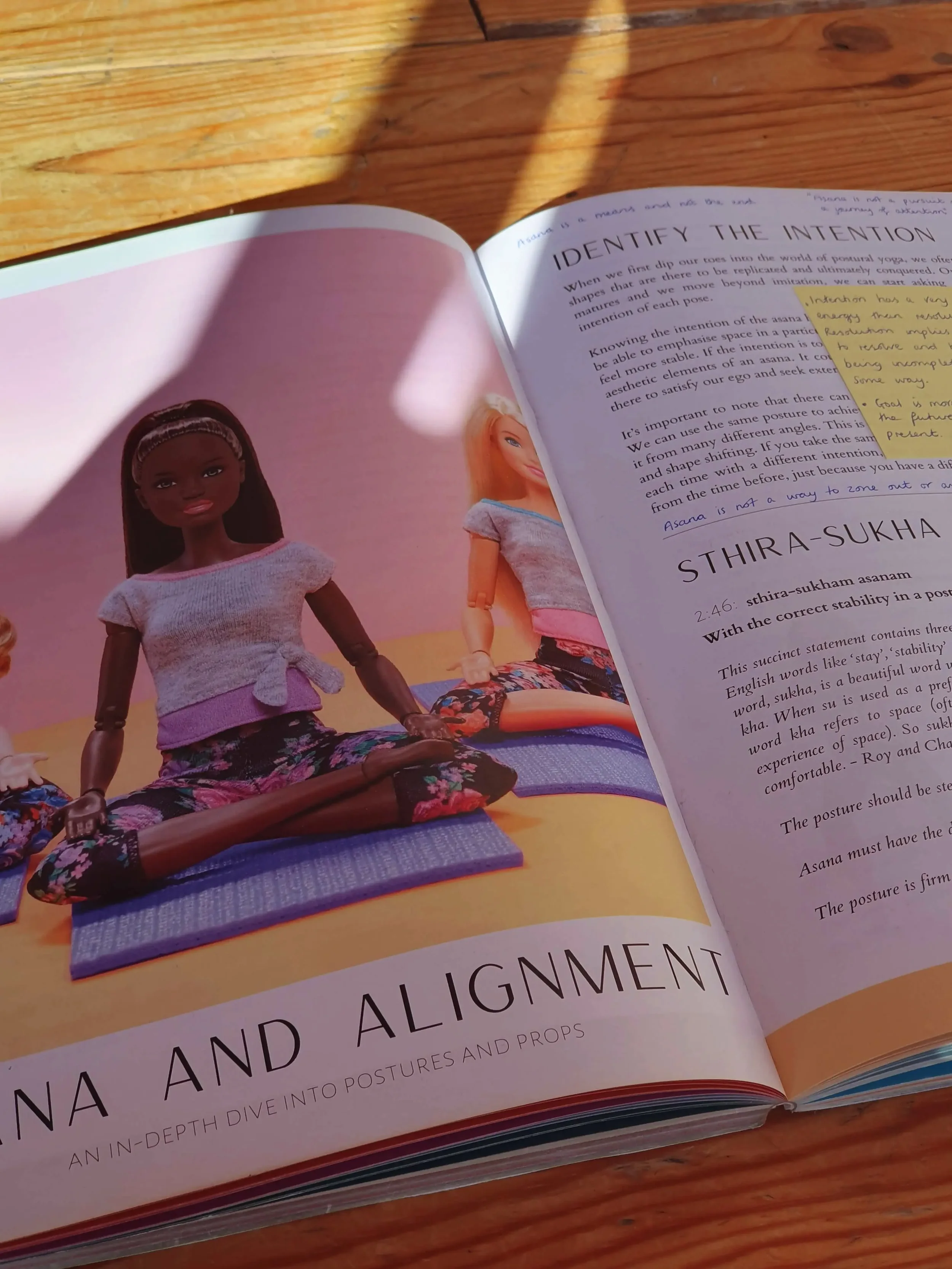
We analyse asanas by breaking down the anatomy, alignment, adaptations, and the potential benefits of each posture.
The emphasis is on understanding why and how a pose works, not trying to make everyone look the same while doing it. We’ll treat asanas as an internal experience, not an external performance.
-
Move away from binary ways of thinking, and let go of the idea that there’s a perfect, correct or advanced version of any pose.
Instead, we’ll take an “it depends” approach to question common cues and personalise the practice to suit individual body shapes, sizes, and skeletons.
-
Understand how one asana can be practiced in many ways depending on your individual anatomy, overall intention, or specific focus.
-
Accessibility isn’t a separate style of yoga - it’s an overall approach.
Learn how to create classes where students of different ages, body types, abilities, backgrounds, and experience levels feel included, supported, and welcome.
This is yoga for everybody, and every body.
-
Props are not only there if you “need” them - they’re the missing ingredient in so many classes. They can make asanas more accessible, but can also make them more challenging or interesting too.
Props are the norm for all my classes - never an afterthought, or only for beginners. We’ll use them to explore the balance of effort and ease, make “peak” poses accessible for everyone, and add an overall playfulness to your practice.
Sequencing
The art and science of planning the perfect class.
-
To help you step into your teaching career with confidence, we’ll work with simple sequences that you can build upon and personalise depending on your own theme and focus.
This foundation serves as a powerful base to guide your students through practices that educate and inspire them both on and off their mat.
-
By the end of the training you’ll be able to plan an awesome, all-levels, class in just 10 minutes.
This is thanks to my personal sequencing structure that I’ve developed over the years. It’s a highlight for many of my YTT students, and incredibly simple to use - and personalise.
We’ll start by deconstructing the guided asana practices to fully understand the structure, then work together to build sequences as a group. By the end you’ll feel fully at ease creating your own classes - and teaching them.
-
As modern day Yoga Teachers there’s a critical need to balance our creative flare with carefully considered movements and asanas. You’re sequencing a yoga class, not choreographing a dance show.
Our goal is to be adaptable and sustainable in our approach, ensuring we meet the needs of everyone in the room.
There are many benefits to both repetition and variety, it’s just about finding the right balance of each.
-
A sequence without a theme is…just a sequence. When you work with a theme, it adds an extra dimension to your class.
Rather than guiding your students through a series of shapes, you’ll give them an opportunity for a much more meaningful experience on their mat.
Whether you prefer an anatomical approach, working with energy, or sharing the philosophy, you’ll leave with a lot of ideas to inspire your class planning.
-
Using earth, water, fire and air as class themes.
Use each element as a guide for structuring your sequence, choosing your asanas, and creating the overall vibe, pace and atmosphere of your class.
This approach works just as well for strong, dynamic flows as it does for slow grounded practices, and it gives your students (and yourself) an experience that feels cohesive and intentional.
Styles of yoga
Yoga - but your way.
-
This YTT isn’t a cookie-cutter approach, so rather than training you in a single “style” of yoga, we work with themed classes.
Some classes lean more anatomical, others work with a specific energy or philosophical topic.
I teach the training in this way because it’s important that you can teach authentically, whether that’s offering powerful and creative flow classes, or something calm and cosy.
I’ll share the tools you need to cover the full spectrum of “styles” so you can teach yoga in a way that works for you - and your students.
-
Scheduled relaxation time. Restorative yoga is a slow, gentle and therapeutic practice designed to nourish your nervous system and support your body into a state of surrender and softness.
You’ll learn how to structure and teach restorative asanas, so you can offer your students something complementary to more dynamic classes - or just make savasana extra special.
-
Feel comfortable guiding meditations or pranayama in your classes.
A great class offers more than just asanas - whether you’re complementing a powerful flow practice, an easy going Sunday evening class, or want to avoid asana altogether and focus only on the breath.
-
Teaching beginners is a huge privilege (and responsibility) because you’re their first entry point into yoga.
You’ll learn the skills and tools to make your classes naturally welcoming, inclusive, and accessible, so new students feel supported, not overwhelmed.
-
Private sessions offer the chance to personalise yoga for the person in front of you.
Whether your student wants a one-off workshop, or a weekly class, you’ll be able to build a programme that helps them achieve their goals.
You’ll learn how to structure 1:1 classes, and how working privately differs from teaching groups.
Practice teaching
Hands-on experience from day one.
-
From the very start of the training you’ll build your confidence as a teacher and gain hands-on experience guiding each other through different parts of the practice.
I promise I won't throw you in the deep end and expect you to figure it out on your own. Instead, we’ll start simple and take small steps at a fun pace.
-
I know teaching can be a little nerve-wracking, which is why we’ll build a strong sense of community.
You’ll be supported by me, but also by your fellow trainees, learning not only from your own experience but from watching and practicing with each other along the way.
Teaching is a team effort before it’s an individual skill.
-
It’s important to me that you grow as an individual and discover your own unique teaching style. I’m not looking to mass produce identical yoga instructors - far from it.
Certain aspects of the course will resonate with you more than others, and that’s completely normal. You’ll be encouraged to explore what works for you, and what doesn’t, so you can teach authentically and never feel forced into a specific mold.
-
It’s one thing to have a wealth of knowledge; it’s another to confidently stand in front of students and guide them through a great class.
This is why we focus specifically on embodiment techniques to help you hold space, project your voice, create a certain energy or atmosphere, and avoid a mid-class panic attack if you forget the left side.
-
Learn how to use gestures and demonstrations, without doing the whole class on your mat. You’re there to support your students, not enjoy a self-practice.
We also cover physical assists - when they’re appropriate (and when they’re not), and how to offer them consensually in a safe and beneficial way - for both you and your students.
-
How you speak matters just as much as what you teach.
Clear, thoughtful communication is at the heart of good teaching, which is why cueing and verbal communication will be a central focus throughout the training.
The aim is to get so good at guiding classes that your students could close their eyes and still follow everything you say.
-
You’ll be encouraged to find your own voice as a teacher, whether you lean toward poetic phrases, or prefer a more literal approach.
We’ll also look at language in more depth so you can choose between internal or external cues, use helpful metaphors, and explain things clearly without the ums and ings.
Mentorship
Because being a successful yoga teacher involves more than just teaching.
-
This part of the training focuses on the realities of working in the yoga world - from finding paid work to building something that’s sustainable long-term.
Whether you want to share yoga online or in-person, there are many options to explore - which is what I’ll help you with.
-
Before teaching yoga full time, I spent years working in marketing and event management - so I can help with this side of things.
I’ll share practical insights from my experience as a studio owner, full-time teacher, and travelling instructor - including mistakes I’ve made, lessons I’ve learned, and things I wish I’d known earlier.
-
Starting your teaching journey can feel overwhelming. That’s why, as one of my graduates, you get mentorship and business guidance included as part of the 200-hour teacher training.
Secure checkout powered by ThriveCart · Spaces are limited
↑
↑
↑ ↑